Choosing a web design agency: a checklist for accessible, compliant business sites
How to choose a web design agency: what to ask about accessibility, speed, search and AI answers, data protection, access and care after launch.
- Nº
- 08
- Published
- Read
- 10 min
- Category
- Notes
- Written by
- Revylio
Choosing a web design agency: put five commitments in writing first
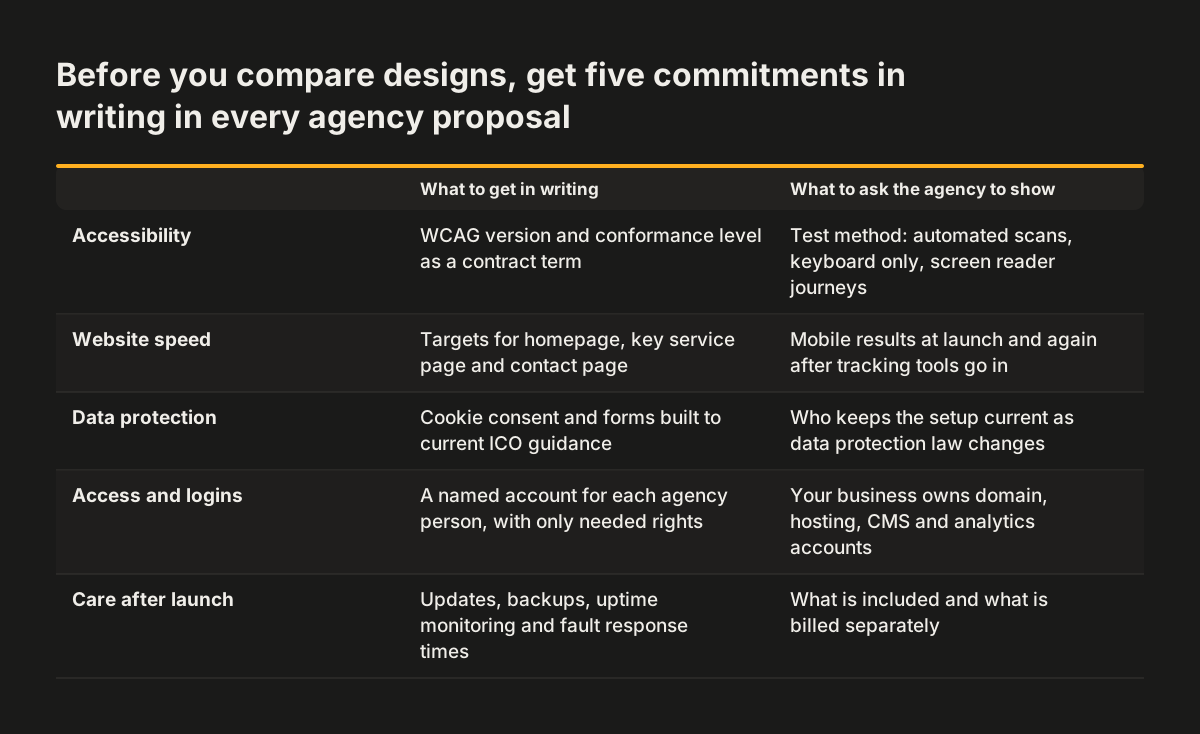
Choose a web design agency that commits, in writing, to accessibility testing, speed targets, data protection, safe access to your accounts and care after launch. Do this before you look at mock-ups. A web design agency is a company that plans, designs and builds websites for clients, and often hosts and maintains them afterwards.
Design taste is easy to judge from a portfolio. The commitments that decide whether a site works for years are harder to see. They only show up in the proposal, the contract and the support terms.
Ask every agency on your shortlist the same five questions:
- Which accessibility standard do you build and test against, and how do you test?
- What speed targets do you commit to, measured on which pages?
- How will the site be structured so search engines and AI answers can quote it?
- How does the site handle cookies, forms and personal data?
- Who looks after the site after launch, and on what terms?
An agency that answers with specifics, named tools and named people is worth a second meeting. An agency that answers with adjectives is not. Portfolio and price still matter, but compare them only between agencies that pass these five questions. When you do look at past work, open the live sites rather than screenshots, as you can with our own published client work.
Accessibility: ask which WCAG standard the agency tests against
A good web design agency names the accessibility standard it builds to and shows you how it tests. WCAG, the Web Content Accessibility Guidelines, sets testable criteria for accessible web content. Ask for the version and the conformance level in writing, in the proposal itself.
Whether accessibility law applies to your business depends on what you sell and where you sell it. Confirm that with your own legal adviser. Then make the agreed standard a contract term, not a sales promise.
Ask how the agency checks its work. The useful answers cover these tests:
- automated scans of every page template
- manual checks with a keyboard only, without a mouse
- checks with a screen reader on key journeys such as contact and checkout
- colour contrast and text resizing checks
- form labels and error messages that make sense when read aloud
Then ask what happens after launch. Your team will add pages, images and documents for years. A template that passes on launch day can fail a month later if editors upload images without alternative text or paste in tables as pictures.
The agency should leave you with editing guidance and, ideally, short training for whoever updates the site. Ask who fixes an accessibility failure found after handover, and whether that fix is covered by the support agreement or billed separately.
Website speed: ask for measured targets on real pages
Ask the web design agency to commit to speed targets measured on your real pages, not on an empty demo. A homepage with no content always loads quickly. The pages that matter are the ones with large images, embedded video, booking widgets and tracking scripts.
Agree three things before the build starts. First, which pages are measured: usually the homepage, a key service page and the contact or checkout page. Second, the conditions: a mobile phone on an ordinary mobile connection, not an office computer on fibre. Third, when the measurement happens: at launch and again after your marketing tools are installed.
Tracking and chat scripts are a common reason a fast launch becomes a slow site. Ask the agency how it loads third-party scripts, and who decides which scripts are allowed onto the site.
Hosting affects speed as much as design does. Ask where the site will be hosted, who manages the server, how images are compressed and served, and whether caching is set up. If you already have a slow site, the order of fixes matters more than the size of the budget. Our guide on what to fix first on a slow website sets out where to start, and the same list makes a useful test of any agency's answers.
Search and AI answers: page structure an agency should deliver
A web design agency should build pages that a search engine or an AI assistant can read and quote section by section. Machines that summarise or quote your site often read one section without the rest. A section that only makes sense next to its neighbours gets quoted badly or not at all.
Ask how the agency handles page structure. The answers you want are concrete:
- one main topic per page, with a literal page title
- headings that describe the content below them, in a logical order
- the answer to the page's main question near the top
- important text written in the page itself, not inside images
- clear, stable addresses for every page
The same structure helps people who scan, and it helps screen reader users who jump between headings. Accessibility and readability for machines share most of their requirements.
If you are replacing an existing site, ask for a redirect plan. Every old address that has traffic or links should point to its new equivalent on launch day. An agency that cannot show you a redirect plan before launch is likely to cost you search traffic you already earned. Ask also who writes the copy: an agency that designs around placeholder text often leaves you with pages that look finished but answer nothing.
Data protection and the ICO: what a compliant site needs from the agency
A web design agency should build cookie handling, forms and data storage that your business can defend to the regulator. In the UK, the regulator is the Information Commissioner's Office (ICO). The ICO says people can report complaints about the use of cookies on a website to it, so cookie consent is not a cosmetic banner.
Data protection law has also moved. The ICO's home page flags the Data (Use and Access) Act 2025 as updating key aspects of data protection law, and offers guidance for private and third sector organisations, public bodies and sole traders. Ask the agency how its cookie and form setup reflects current guidance, and who keeps it current.
Ask these questions about personal data on the site:
- Which cookies and scripts load before a visitor consents?
- Where do form submissions go, and who can read them?
- Where is the site hosted, and where are backups kept?
- Which outside services receive visitor data, such as analytics or chat tools?
You can also check the agency itself. The ICO's public register of data controllers lists organisations registered under the Data Protection Act 2018. The ICO advises searching one field at a time, preferably the registration reference. Registration counts from the date the ICO receives payment, and changes can take up to two working days to appear.
Access and logins: never give a web design agency your own password
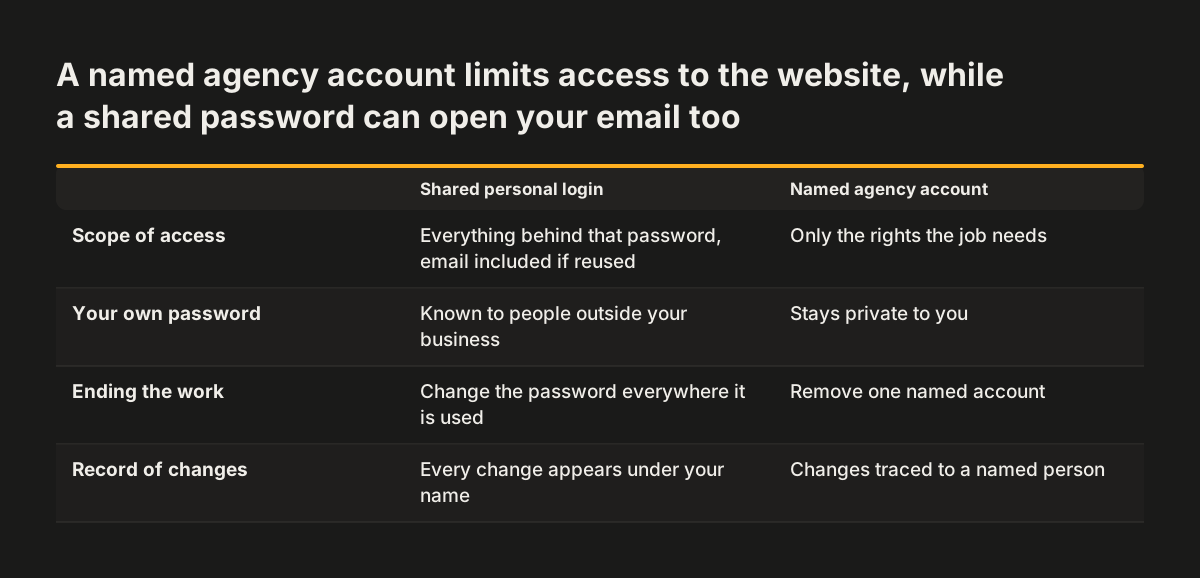
Give a web design agency its own accounts, never your personal login. A shared password hands over far more than the website. On a site builder's community forum, a business owner described exactly this problem: their website login used the same password as their email, so sharing it with an outside designer would also give that designer complete access to their mail.
The safe pattern is simple. Each person at the agency gets a named account with only the rights the job needs. Your business stays the owner of every account: domain, hosting, the content management system, analytics and any form or email service.
At Svennis we create a separate named account for every outside designer or developer before work starts, and we remove those accounts on the day of handover. The gap we find most often at new clients is a former supplier who still holds administrator access to a live site.
Ask the agency for a written access list at the start of the project and again at handover. The list should name each account, its owner, its level of access and the date it will be removed. Ask also who holds the domain registration. If the agency registered the domain in its own name, ask for it to be transferred to your business before launch.
Post-launch care: who maintains the site after go-live
Agree who maintains the site after launch before you sign for the build. A website needs updates, security patches, backups and fixes for as long as it runs. If nobody owns that work, it does not happen until something breaks.
Ask the web design agency to set out its care terms in writing. A useful agreement covers:
- software and plugin updates, and how often they are applied
- backups: how often, where they are stored and how quickly a restore happens
- uptime monitoring and who is alerted when the site goes down
- response times for urgent faults and for routine changes
- accessibility and speed checks after content changes
- what is included and what is billed separately
Test the forms as part of care, not just at launch. A contact form that quietly stops sending leads can go unnoticed for weeks. Forms should feed a system your team works from, as we explain in why your contact form should not end in an inbox.
Finally, ask what happens if you leave. You should receive the site files, the database, all account access and the documentation. An agency that makes leaving difficult has told you how it plans to keep you.
Agency directories: use the shortlist, then verify every claim
Agency directories are a fair starting point for a shortlist, but their rankings are not a quality check. Each directory sorts and labels agencies in its own way. Read the method before you trust the order.
Semrush, for example, publishes a list of the top 15 B2B services web design companies in London, sorted by its own Agency Score. The same page has a separate section for companies that have no physical office in the area but work and have clients there. If meeting in person matters to you, check which section an agency sits in.
Local directories mix very different businesses under one heading. The Hastings Creatives web design directory lists web design agencies alongside a freelance user researcher, a graphic designer working with museums and galleries, and a music and tech tutor. A category label tells you little about what a listed business actually builds.
Treat every listing as a claim to verify. Open the live sites in the agency's portfolio. Run them through the accessibility and speed checks you plan to demand of your own site. Ask for a reference from a client whose site launched more than a year ago, so you hear about the care after launch, not just the build.
Next steps: write the brief before you contact a web design agency
Write a one-page brief before you contact any web design agency. A brief makes proposals comparable and keeps the conversation on outcomes rather than on style. Work through these steps in order:
- Decide whether you need a new site at all. Our guide on when a website redesign pays off, and when to fix the site in place helps you choose.
- List your key pages and the one question each page must answer.
- Confirm with your adviser which accessibility obligations apply to your business, and name the standard you expect.
- Write down the pages to measure for speed and the conditions for measuring them.
- List every account the site depends on and who owns each one today.
- Set out the care you expect after launch: updates, backups, monitoring and response times.
Send the same brief to three agencies and compare the written answers side by side. Budget comes next. Our article on what actually drives website redesign cost explains which choices move the price. If you want us among the agencies you compare, our website redesign service covers accessibility, speed, data protection and maintenance as part of the build.