Website redesign: when it pays off, and when to fix the site in place
A redesign pays off when your site fails on accessibility, speed, search or data protection. Here is how to tell whether to redesign or fix in place.
- Nº
- 05
- Published
- Read
- 12 min
- Category
- Notes
- Written by
- Revylio
A redesign pays off when the site fails, not when it looks dated
Website redesign: when it pays off comes down to failures, not fashion. A redesign pays off when your current site fails on accessibility, speed, search visibility or data protection, and the failures sit in the templates and the platform. A dated look on its own is a weak reason. If the problems are confined to a few pages, fixing in place usually costs less.
A website redesign is the rebuilding of a site's structure, templates and design. It keeps the domain, the useful content and the search traffic you have already earned. It is more than a new colour scheme. It changes how every page is built, so it fixes problems that repeat across the whole site.
The distinction matters because the two options solve different problems. A fix in place repairs specific pages, images or settings. A redesign replaces the shared parts that every page inherits. When the same fault shows up on every page, the template is the cause, and patching page by page becomes the expensive route.
This guide covers the signs that a site is costing you enquiries and what a redesign changes. It also covers typical timelines and what your company prepares. It ends with a decision table, a worked example and practical next steps.
Signs your current site is costing you enquiries
A site costs you enquiries when visitors who want to contact you cannot finish the journey. Start with the evidence you already hold: traffic, the number of enquiries, and which pages search engines actually show. Revylio's redesign process opens with exactly those three questions in its Discover stage.
Watch for these signs, each of which points to a specific failure:
- Keyboard users cannot reach the main content or the contact form without tabbing through every menu item.
- Pages load slowly on a phone, even when the content is short.
- Pages that used to bring visitors from search now return errors after an earlier move.
- The cookie banner loads tracking before the visitor has made a choice.
- Forms ask for more personal data than you need to reply.
- Nobody on your team can change a page without calling a developer.
One sign on one page is a maintenance task. The same sign on every page is a template problem. Count how many pages each sign affects before you decide anything. That count is the most useful single input to the decision between redesign and repair.
Write the counts down with the date. They become your baseline, so you can judge after launch whether the new site has changed anything.
Accessibility failures that a redesign fixes at the template level
Accessibility is the strongest case for a redesign, because most accessibility features live in the templates. When the template lacks them, every page fails in the same way. When the template has them, every page inherits them at once.
The Justice AI Unit's write-up of its own website redesign, published in April 2026, shows what this looks like in practice. The rebuilt site includes three template-level features:
- A skip-to-content link as the first focusable element on every page, so keyboard users jump straight past the menu.
- ARIA landmarks on every major section. ARIA landmarks are labels in the code that tell screen readers where each region of a page begins.
- Reduced-motion handling that respects the operating system setting across all animated components.
None of these features is visible in a design mock-up. All of them are decided once, in the shared components, and then apply site-wide. That is why a theme without them is costly to repair page by page.
If you sell to customers in the EU, ask your adviser whether the European Accessibility Act applies to your site. The answer affects how urgently template-level accessibility work needs to happen. Either way, test the current site with a keyboard alone before you choose between redesign and repair.
Speed problems that sit in the build, not the content
Site speed pays for a redesign when the slowness comes from how the site is built and served. It does not justify one when a handful of oversized images are the cause. Find out which you have before you spend anything.
The Justice AI Unit site is an example of a build chosen for speed. It is fully statically generated at build time and served from a CDN, with no server runtime. Static generation means every page is produced as a finished file in advance, rather than assembled on a server each time someone visits. A CDN, or content delivery network, stores those files on servers close to your visitors.
A platform that builds every page on request, loads a heavy theme and runs many plugins cannot be made fast by compressing images. That is a structural limit, and structural limits are what a redesign removes. A site that is slow only on two or three pages with large photos needs a fix in place.
Measure on the live site, not on a demo. Revylio measures Core Web Vitals, the loading and responsiveness scores that search tools report, on the real site after launch rather than on a template in a demo. Ask any supplier where and when they will take the same measurement.
Search rankings survive a redesign only with a redirect map
A redesign protects your search traffic only if every old address points to its new one. Without that, pages that rank today return errors tomorrow, and the visitors they brought disappear. This is the single most common way a redesign destroys value instead of creating it.
A 301 redirect is a permanent instruction that sends anyone requesting an old page address to the new address. A sitemap is a file that lists every page you want search engines to find. Revylio's website redesign service gives every changed path a 301 and resubmits the sitemap at launch. As the page puts it, the redirects are what stop a move being a fall.
At Svennis, we export every live URL before any design work starts and map each one to its new address, and that map is signed off before the build begins. The failures we see come from maps drawn up in launch week, when a forgotten folder of old pages is discovered too late.
The redirect map is also a test of whether you need a redesign at all. If your current addresses are clean and your rankings are stable, a fix in place keeps them untouched. If earlier moves left broken addresses, a redesign is the moment to repair them properly.
GDPR and cookie consent: what the site must collect and default to
Data protection justifies a redesign when consent, tracking and forms are wired into the site in a way you cannot change without rebuilding. Many older sites load analytics before consent and collect form fields nobody uses. Those faults often live in theme code and plugins rather than in settings you can switch off.
Tandridge District Council's site shows a clear way to separate cookies. Strictly necessary cookies are those the site needs to function, such as the ones set when you log in, and they cannot be switched off. Performance cookies let the council monitor traffic to improve the site, and visitors can switch them on or off. Your banner should present categories this plainly. Nothing that needs consent, such as advertising or cross-site tracking, should load before the visitor chooses. Simple analytics used only to improve your own site can run without consent, as long as you explain them clearly and make it easy to opt out.
If children are likely to use your site, the ICO's age appropriate design code applies. It is a statutory code of 15 flexible standards that explains how the UK GDPR applies to children using digital services. The code requires high privacy settings by default, the minimum personal data collected and retained, and geolocation switched off by default. It also says nudge techniques should not push children to share unnecessary data or weaken their privacy settings.
Audit every form and every script against these rules. Two or three fixes are a maintenance job. A site where consent is bolted on everywhere is a redesign.
Redesign or fix in place: a decision table
The choice between a redesign and a fix in place depends on how widespread each problem is. Use the table below to sort your findings from the audit. Read across each row and note which column describes your site.
| Problem area | Fix in place when | Redesign when |
|---|---|---|
| Accessibility | A few pages lack alt text or have poor contrast | The template has no skip link, no landmarks and no keyboard route |
| Speed | A few pages carry oversized images | Every page is slow because of the platform, theme or plugins |
| Search | Addresses are clean and rankings are stable | Earlier moves left broken addresses and the structure confuses visitors |
| Privacy and consent | One script loads too early or one form asks too much | Tracking and consent are built into theme code you cannot change |
| Editing | Your team can update pages but some layouts are awkward | Every change needs a developer |
| Look and feel | The site works well but looks dated | The look is dated and at least one row above also says redesign |
One redesign row is a reason to get a scoped quote. Two or more usually mean the platform itself is the problem, and patching will cost more over time than replacing. A site that only looks dated, with every other row in the left column, rarely pays back a full redesign.
Worked example: how Argyll and Bute Council scoped and bought a redesign
Argyll and Bute Council's Drupal website redesign shows how a buyer can scope and run a redesign. The council's contract award notice on Public Contracts Scotland sets out the details, and you can follow the same logic for a private company.
What the council asked for
The council wanted to redesign the look and feel of its current website and sought a single partner supplier. The scope covered both the redesign and the implementation. That point matters: a design that nobody is contracted to build leaves you with pictures, not a working site.
How it chose and how long it took
The contract notice was published on 11 February 2022, with a deadline of 4 March 2022. The contract was concluded on 8 April 2022, under an open procedure. Six tenders arrived, all from SMEs. The award criteria weighted quality at 60 and price at 40, and the contract went to an SME in Perth for a total value of £31,000 excluding VAT.
What you can copy
Write down what the redesign must achieve before you ask for prices. Make sure every quote includes building the site, not only designing it. Weigh quality above price, as the council did. Allow time for choosing a supplier: here, selection alone took about eight weeks from notice to contract.
Redesign timelines and what your company prepares
A redesign timeline depends mainly on the number of pages and the amount of existing content. Revylio agrees a schedule at the scope stage for that reason, rather than quoting a fixed length in advance. Pricing follows the same inputs: how many pages there are, how much content exists, and what has to connect to what. You can see how that works on the Revylio website redesign page.
Revylio's process runs in six stages: Discover, Structure, Design, Build, Connect and Launch. Your preparation shortens the first two, which is where most delays start. Gather these items before the first meeting:
- Access to your analytics and search console accounts.
- A list of every live page address, with the ones that bring traffic marked.
- Your enquiry figures for recent months, from the baseline you recorded earlier.
- Every form on the site, with the fields it collects and where submissions go.
- Logins for the domain registrar and the current hosting.
- The systems the site must connect to, such as booking, payments or a CRM.
- One named person who can approve content and decisions.
The last item matters most. Redesigns stall when nobody can sign off a page. A named approver with time set aside keeps the agreed schedule realistic.
What a redesign decision means for a UK business
For a UK business, the redesign decision sits inside UK data protection rules and the Equality Act 2010, which expects service providers, websites included, to make reasonable adjustments for disabled people. If you sell into the EU, the European Accessibility Act may apply as well. All of these point at the same weak spots: templates, forms and consent. A site that fails these checks carries risk as well as lost enquiries.
The ICO's age appropriate design code is a good example of that risk. The code is not a new law, but it explains how the GDPR applies to children online, and companies that do not make the required changes risk regulatory action. The ICO notes that one in five UK internet users are children. If your products, events or services might attract younger visitors, the code is relevant to your site.
UK public bodies also show what a sound purchase looks like. Argyll and Bute Council ran an open procedure and weighted quality above price. Tandridge District Council's site lets residents manage services online through a MyTandridge account and explains its cookie categories in plain terms. Both are useful benchmarks when you write your own brief.
If you trade with EU customers, add the European Accessibility Act to the questions you put to your adviser. Then return to the decision table. The legal questions do not change the method. They change how urgent the accessibility and privacy rows are.
Next steps: audit the site, then decide redesign or repair
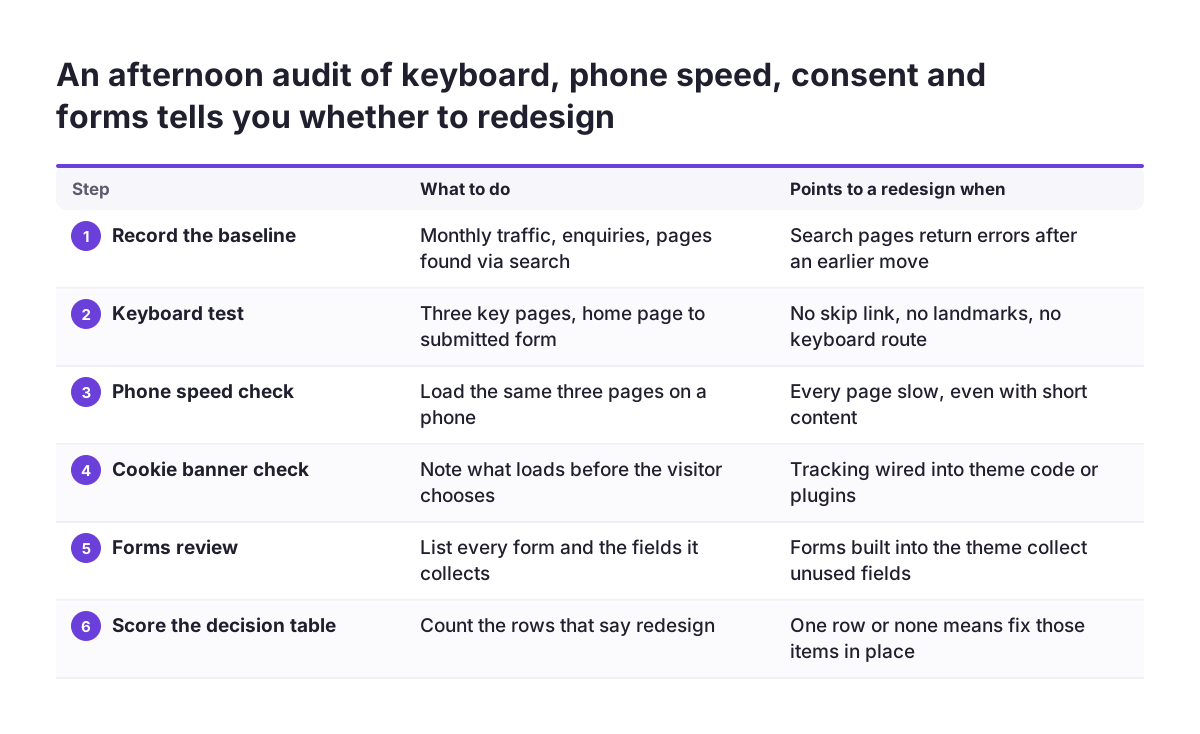
The next step is a short audit of your current site, done before you speak to any supplier. It takes an afternoon and gives you the evidence to decide between a redesign and a fix in place.
- Record your baseline: monthly traffic, monthly enquiries and the pages that bring visitors from search.
- Test three key pages with a keyboard only, from the home page to a submitted form.
- Check load times on a phone for the same pages.
- Open the cookie banner and note whether anything loads before you choose.
- List every form and the fields it collects.
- Fill in the decision table and count the rows that say redesign.
If you have one redesign row or none, fix those items in place and repeat the audit in six months. If you have two or more, a scoped redesign is likely to pay off. Bring your audit to the Revylio website redesign team for a scope and schedule based on your pages, content and integrations.
Before that conversation, look through the examples of Revylio's past website work. It helps you decide what you want the new site to do, not only how it should look.