Getting cited in Google AI Overviews starts with how your website is built
AI Overviews cite pages they can read. See how structure, speed, accessible markup and short direct answers help a small business site get cited.
- Nº
- 11
- Published
- Read
- 12 min
- Category
- Notes
- Written by
- Revylio
Getting cited in Google AI Overviews starts with a page Google can read
Getting cited in Google AI Overviews starts with a page that Google can read. That means clear headings, a short direct answer near the top, fast loading and proper HTML. Google says creators need nothing special beyond its regular Search Essentials guidance. On many small business sites, the real blocker is an old build rather than the writing.
A Google AI Overview is a generated answer block that sits above the organic results. It combines information from several web pages and shows inline citation chips that link to each source. Google first tested the idea in May 2023 as Search Generative Experience (SGE), an opt-in experiment in Google Labs. AI Overviews replaced SGE in May 2024 as a default feature for US queries.
This guide covers four things:
- how the feature chooses its sources
- what zero-click searching means for your site
- what cited pages have in common
- how to check one page on your own website
It ends with a checklist and a worked example you can follow on a single service page.
How AI Overviews choose the pages they cite
AI Overviews draw their sources from pages that already do well in ordinary Google search. Recent studies show that around 50% of the sources cited in AI Overviews rank in the top 10, according to Keywords Everywhere's guide to AI Overview citations. Normal search visibility therefore comes first.
Gemini is the foundation model that writes the summaries. The feature also relies on other Google Search technologies, including retrieval-augmented generation. Retrieval-augmented generation (RAG) is a method in which the system fetches relevant pages first and then writes its answer from them. If your page is not among the pages fetched, it cannot be cited.
A single answer draws on several sources:
- an average of 7 to 8 sources per query, according to Keywords Everywhere
- around 13 sources on average in expanded AI Overviews
- 2 to 4 sources combined into one generated paragraph, according to Setproduct
Each source usually supplies one passage, not the whole page. A page that states one clear answer in one clear place gives the system something it can lift and credit.
Google's own position, quoted in the Keywords Everywhere article, is short: "There is nothing special for creators to do to be considered other than to follow our regular guidance for appearing in search." In practice, that means three things. Rank for the question, make the page easy to read, and answer precisely.
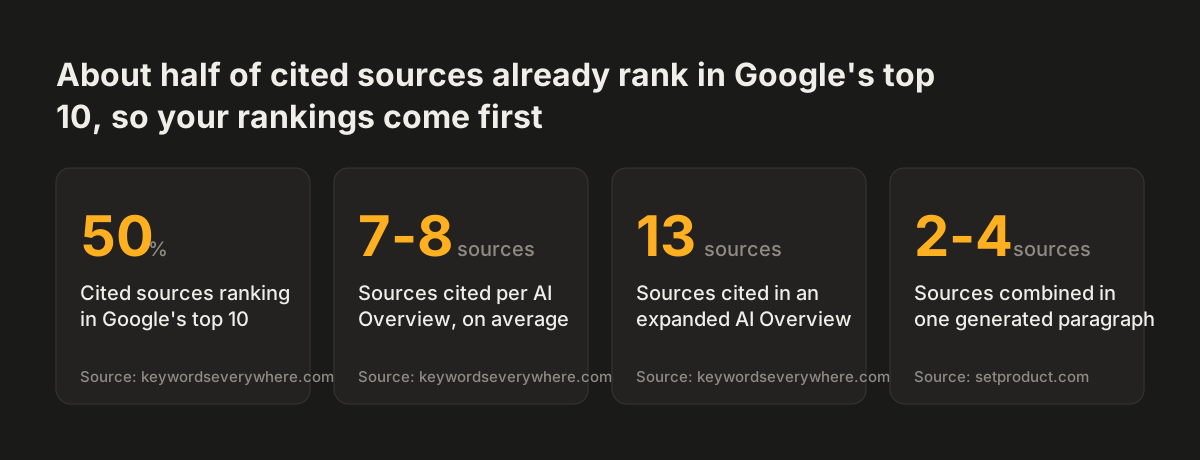
Source: keywordseverywhere.com, setproduct.com
Zero-click searches change what a small business website is for
Zero-click searching means the searcher reads the answer on Google's results page and does not visit any site. Publishers fear a scenario called "Google Zero", in which people find everything they need on Google's own pages. That would leave fewer openings for independent websites.
Estimates of how often AI Overviews appear depend on what each study measures:
- Advanced Web Ranking, cited by Keywords Everywhere: over 50% of all Google searches, up from 25% in August 2024
- Semrush's AIO study, cited by Setproduct: roughly a third of informational queries
- Ahrefs: informational keywords trigger AI Overviews 99.2% of the time
The summaries are generally 150 to 250 words long, and longer for complex queries. That is often enough to answer the question outright. The informational questions your customers ask before they buy are exactly where AI Overviews appear.
Fewer clicks do not have to mean less business. According to Keywords Everywhere, HubSpot itself claimed an 80% drop in traffic in 2024 alongside 21% revenue growth that year. The aim shifts from collecting visits to being the source that the answer names.
The competition for citations is also changing. Reddit's share of AI Overview citations has climbed to around 6%, and Quora's to nearly 4.5%. Google has also started placing sponsored results inside AI Overviews, each one marked "Sponsored".
A dated website is often the real blocker to AI Overview citations
An older business website often hides good answers in a form that machines struggle to separate and quote. The writing may be accurate. The problem is how the page is built: decorative headings, long unbroken blocks, slow templates and text that only appears once scripts have run.
When Svennis audits an older business site, we often find the answer a searcher wants buried under a banner and the company history, with headings that are only styled text rather than real heading tags. We fix the structure before we rewrite a word, because a machine cannot cite a passage it cannot separate from the rest of the page.
Three areas of the build decide whether a page can be cited:
- Structure. Real headings in a logical order let a system find the question and the passage that answers it.
- Speed. A slow site loses visitors and makes every other fix harder to measure. Our post on what a slow website costs in enquiries shows how to find the leak.
- Accessible markup. Text in the HTML, text alternatives for images and a clear heading order serve screen readers and machines alike. Our guide to the European Accessibility Act and WCAG 2.1 AA covers the standard in detail.
For a wider view of how AI tools read pages, see how AI assistants read your website, and what to fix first.
What cited pages had in common in one published study
The clearest public evidence on page patterns comes from Setproduct. It studied 29 verified AI Overview citations across its own content, checked against the Ahrefs AIO tracker. Its teardown of how its articles got cited in AI Overviews found that every cited article shared three features:
- question-based H2 headings
- at least one short direct-answer paragraph early in the content
- a named author with a linked bio page
The study has limits, and you should weigh them. The author says the findings are observations, not a controlled experiment, and no A/B tests were run. The site is also not typical of a small business. It is a DR 42 domain with 2,700+ referring domains, 167 published articles and nine years of age, and it is included in Google News.
The study also describes the length of a good answer. The system looks for a self-contained paragraph that answers the query in roughly 40 to 70 words. Setproduct stresses that this window is an industry-observed pattern, not a specification published by Google. Treat it as a sensible target, not a rule.
Authorship has firmer backing. Google's Search Central documentation on helpful content names author identity and bylines as trust signals. Adding a named author with a real bio page is a small change with an official basis.
Structured data labels your answers but does not guarantee a citation
Structured data is code added to a page that labels its content for search engines. For example, it can mark a set of questions and answers as an FAQ. FAQ schema is the structured data type that does this.
Setproduct's findings show both the value and the limit. Every one of its 29 cited articles had FAQ schema. Many of its articles with FAQ schema were never cited. The markup appears to help a strong page, but it does not lift a weak one.
Some structured data types have lost visibility. Google has largely deprecated the visual treatment of HowTo rich results, according to the same study. Before you pay for markup work, check that the type still shows in search.
A sensible rule for a small business site has three parts:
- Add FAQ schema only where the page really contains questions and answers.
- Make sure the marked-up answers match the visible text exactly.
- Mark up the author and link the byline to a bio page.
On older sites, the theme or page builder often cannot add structured data without custom work. That limit is one of the clearest signs that the build, not the content, is holding the site back.
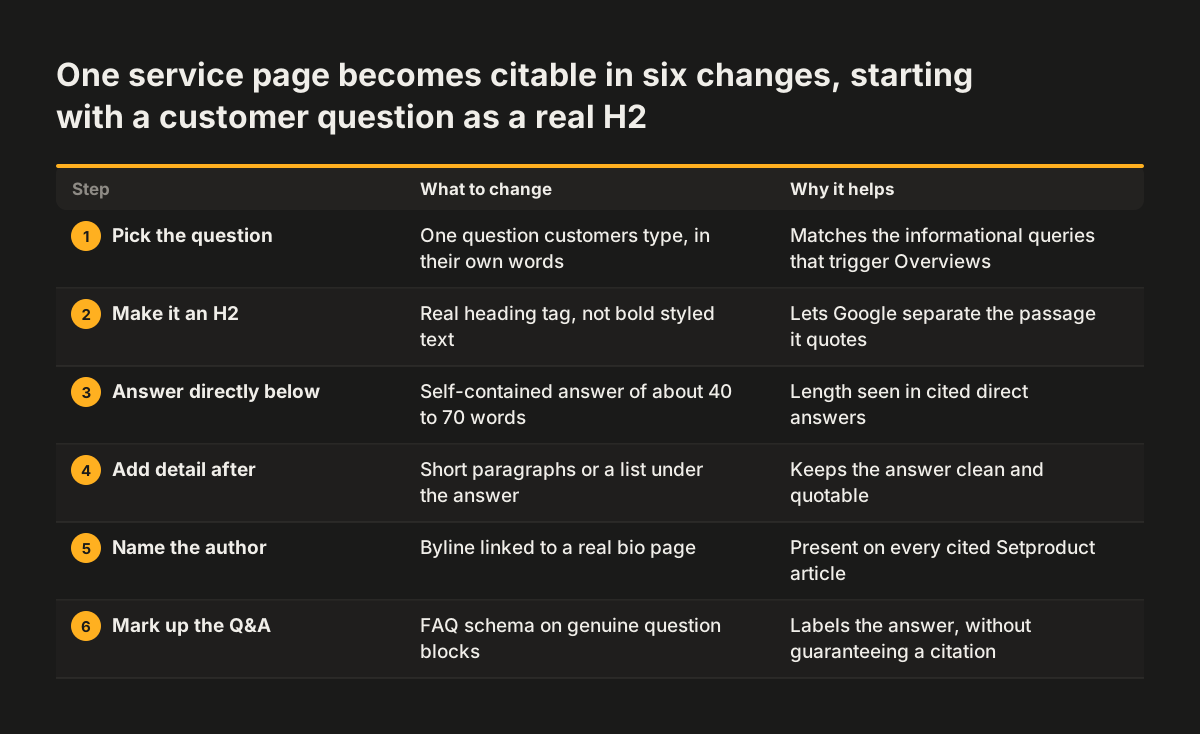
Worked example: rewriting one service page so AI Overviews can cite it
Take a typical service page for a commercial cleaning company. Today it opens with "Welcome to our services", runs three paragraphs of company history, and answers the customer's real question in paragraph four. The headings are bold text, not heading tags. No author is named.
Follow these steps on that one page:
- Pick one informational question that customers ask, phrased the way they would type it.
- Make that question an H2 heading, as a real heading tag.
- Directly beneath it, write a self-contained answer of about 40 to 70 words that names the subject. A reader should not need the heading to understand it.
- Put the supporting detail after the answer, in short paragraphs or a list.
- Repeat this pattern for two or three related questions on the same page.
- Add a byline naming the person who wrote or checked the page, linked to their bio page.
- Add FAQ schema that covers the question-and-answer blocks, matching the visible text.
- Reload the page on a phone and check that the text appears at once, without waiting for scripts.
After the rewrite, the page holds the same facts in a new order. The answer comes first, the question is a real heading, and a named person stands behind it. Nothing in the business changed. The page simply became something a machine can quote.
Expect some of these steps to fail on a dated site. If the page builder will not create real headings or add schema, write down where it stops. That list tells you whether a repair is enough.
Checklist: what AI Overviews need and where older websites fall short
The table below compares what a citable page needs with what a dated site often does. Use it to audit one important page before you change anything else.
| What a citable page needs | What a dated site often does | What to fix |
|---|---|---|
| Readable structure | Headings styled as bold text, one long block | Real H2 and H3 headings, with questions as H2s |
| A direct answer | Answer buried under an introduction | A self-contained answer of about 40 to 70 words under the heading |
| A named author | No byline, or "Admin" | A byline linked to a real bio page |
| Structured data | None, or a theme that cannot add it | FAQ schema on genuine question-and-answer blocks |
| Speed | Heavy templates and slow loading | Core Web Vitals measured on the live site |
| Accessible markup | Text inside images, missing text alternatives | Text in the HTML, alternatives for every meaningful image |
| Existing rankings | Old URLs changed without redirects | A 301 redirect for every changed path |
A page that fails one or two rows can usually be repaired in place. If a page fails most rows, and the cause is the platform rather than the content, the site itself is the obstacle.
AI Overview citations take months, so protect existing rankings while you change the site
AI Overview citations arrive slowly. In Setproduct's study, no article was cited within its first few weeks of publication, and most citations appeared months after the article went live. Judge your changes over months, not days.
Your existing rankings matter during any change. Around half of cited sources rank in the top 10. A redesign that loses rankings can therefore cost you citations as well as visits.
Redirects are the safeguard. On Revylio's website redesign service, every changed path gets a 301 redirect and the sitemap is resubmitted at launch. A 301 redirect is a permanent forward from an old address to its new one. As the same page puts it: "The redirects are what stop a move being a fall."
Speed needs checking on the real site, not on a demo. Revylio measures Core Web Vitals on the live site after launch. Core Web Vitals are Google's measures of how fast and stable a page feels to a visitor. If speed is your weakest row, start with what to fix first on a slow website.
What AI Overviews mean for a UK business website
UK searchers already see AI Overviews. As of May 2025, the feature reached over 1.5 billion monthly users in over 200 countries and 40 languages. Google also made it available to signed-out users and in Incognito mode. Google accounts for 89.74% of the search engine market, according to Keywords Everywhere.
Author bios raise a data protection point. A named byline and bio page publish personal data about your staff, so the UK GDPR applies. The ICO lists seven data protection principles: lawfulness, fairness and transparency; purpose limitation; data minimisation; accuracy; storage limitation; integrity and confidentiality (security); and accountability. Lawfulness means you need a valid lawful basis before you publish a bio.
In practice, agree the bio content with each person, keep it to what supports their expertise, and update it when they leave. The ICO's UK GDPR guidance and resources cover the detail.
Some sectors face closer attention. YMYL, short for "Your Money or Your Life", covers financial, medical, legal and news-related topics. E-E-A-T stands for Experience, Expertise, Authoritativeness and Trustworthiness. If your firm works in finance, health or law, named and qualified authors carry more weight, because Google treats bylines as trust signals.
Accessibility work pays twice. Clean, accessible markup serves disabled visitors and helps machines read the page. If you sell services the European Accessibility Act covers, such as online shopping, to consumers in the EU, the same work supports compliance with it.
Next steps: test one page, then decide whether to repair or redesign
Start with evidence from your own market before you change anything. These steps take an afternoon:
- Search three questions your customers ask before they buy. Note whether an AI Overview appears and which sites it cites.
- Open your own page for each question. Check it against the checklist table above: heading, answer position, byline, schema, speed.
- Rewrite one page using the worked example, then leave it for several months before you judge the result.
- Write down every step your current platform would not let you do.
That last list decides your route. If the platform let you make every change, keep improving the site in place. If it blocked real headings, structured data or acceptable speed, the build is the problem. Our post on when a website redesign pays off, and when to fix the site in place helps you weigh the two options.
If a rebuild looks likely, Revylio's website redesign page explains the process stage by stage. Revylio prices work on page count, existing content and the integrations required, and agrees the schedule at the scope stage.